Over the past few years, conversations around algorithmic transparency, explainability and fairness in music discovery have moved from theory to policy-level concern.
Streaming recommenders now sit at the center of music consumption and discovery, yet the logic governing these systems — and the effect they have on content representation across markets and cultures — remains largely opaque. For cultural institutions and policymakers, this reality raises a fundamental question:
How equitably do algorithms represent local music — especially in multilingual, culturally diverse markets?
In 2024, Music Tomorrow partnered with APEM (Association des Professionnels de l’Édition Musicale) to explore this exact question. The project took shape as a comparative algorithmic visibility study, focusing on the representation of local, non-anglophone repertoire in France and Canada / Québec. The aim was to observe, measure, and explain how recommendation systems expose local and global music scenes in these countries — and what that behavior implies for the cultural representation of local content.
About the Partner
APEM represents music publishers and rights holders in Québec and across Canada, with a long-standing mandate to support the visibility and sustainability of francophone repertoire. For APEM, understanding the impact of platforms on discoverability is not a marketing exercise, but a structural concern, tied directly to cultural diversity, export potential, and the long-term health of the francophone and Québec music ecosystem in Canada.
The Scope of the Study
The study was designed as a cross-market snapshot of how Spotify’s recommendation system positions and surfaces different types of music.
Rather than looking at individual artists or releases, we focused on patterns — examining how language, geography, and artist origin correlate with algorithmic exposure and positioning at scale. To achieve this, the analysis covered a selection of tracks appearing on Spotify charts in both France and Canada over the same time period, allowing for direct comparison between the two markets.
Tracks were grouped along a small number of clear dimensions: artist origin and track language. This allowed us to create a set of comparable categories in each market that could be observed side by side — for example, comparing francophone tracks by local artists in Canada with local francophone tracks in France.
The intent, however, was not to rank individual artists or releases, but to produce clear, comparable KPIs describing how different repertoires are positioned and surfaced by the recommendation system — allowing us to measure visibility patterns at the catalog and market level.
Defining Algorithmic Positioning and Visibility
As a first step, we focused on algorithmic positioning: the way tracks are positioned within Spotify’s recommendation landscape.
Leveraging Music Tomorrow’s algorithmic mapping models allowed us to assess whether the analyzed tracks were surrounded by a broad and varied set of related artists and audiences, or whether they tended to circulate within the same inner circles. These structural differences matter, as they shape how easily music can travel beyond its initial audience — and how often it is introduced to new listeners through algorithmic features.
By comparing these positioning patterns across markets and repertoire types, the study was able to identify systemic tendencies, rather than isolated success stories or one-off outcomes.
Beyond structure, we also examined algorithmic visibility — estimating how strongly different categories of tracks are actually surfaced to listeners through recommendations.
Here, the focus was on relative exposure: how much algorithmic attention local repertoire receives compared to international content, and how that balance shifts between France and Canada. Looking at visibility through both a global and a local lens allowed us to distinguish between tracks that circulate internationally and those that remain largely contained within their home market.
This distinction proved particularly important when examining francophone repertoire, whose reach and treatment varied significantly depending on market context.
Key Findings
Across both markets, we observed a consistent pattern.
International, English-language repertoire tended to occupy broader algorithmic spaces, connecting to a wider range of artists and listener communities. Local French-language music, by contrast, was more often positioned within narrower, more specialized recommendation environments.
While this difference existed in both France and Canada, it was especially pronounced in the Canadian / Québécois context: when we examined the data more closely, Québec-based francophone artists consistently appeared as the most tightly clustered group, suggesting that their music primarily circulates within smaller, localized streaming communities.
From an algorithmic perspective, this means fewer natural pathways for discovery beyond an artist’s immediate audience — and fewer opportunities for crossover into adjacent scenes.
When we shifted our attention from positioning to visibility, similar disparities became apparent.
On a global level — unsurprisingly — French-language repertoire remained less visible than international English-language content in both markets. However, when we focused specifically on local algorithmic visibility, the picture changed significantly.
In France, local French-language artists benefited from relatively strong algorithmic support within their home market. Recommendation systems appeared more likely to surface domestic repertoire to French listeners, helping sustain local content circulation.
In Canada, the study did not find the same level of local reinforcement for francophone artists. Even within Québec, French-language repertoire tended to receive less consistent algorithmic support than what we observed for French artists in France. Across our dataset, on average, Francophone artists in France received ~12 times more algorithmic exposure in their local market compared to their Canadian counterparts — pointing to evident disparities in how language and geography influence content exposure.
The chart below highlights that pattern: while French artists in France receive varying degrees of local algorithmic exposure, Canadian francophone artists are consistently concentrated in the lowest local outreach bracket — consistently outperformed by both local artists performing in English and international acts.
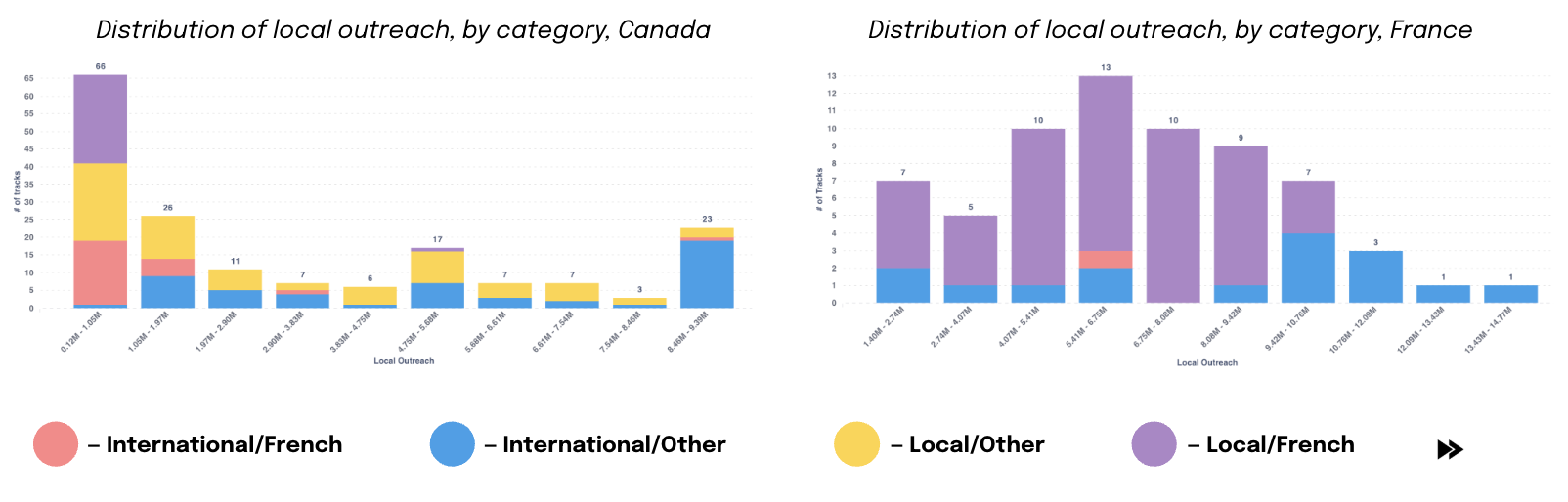
Interestingly, this pattern was far less pronounced among Canadian artists performing in English.
Within this group, our analysis revealed a clear split between artists whose algorithmic exposure remained largely local and those whose recommendation footprint skewed strongly international. This suggests that English-language Canadian artists are better positioned to move between local and global algorithmic contexts — a flexibility that francophone artists appeared to have far less access to.
Implications for Cultural Representation
Taken together, these observations point to a structural challenge rather than isolated patterns.
While international English-language repertoire benefits from broad, flexible algorithmic circulation, we found that French-language music — especially in Canada and Québec — is more often framed in ways that limit both reach and visibility, even within its home market.
The contrast between France and Canada also shows that these dynamics are not inevitable. Algorithmic treatment of local repertoire depends heavily on market context — and can either reinforce or mitigate existing cultural imbalances.
This study both provides a blueprint for future transparency and representation assessments and highlights the importance of looking beyond surface-level platform presence when evaluating the cultural impact of recommendation systems.
Understanding how algorithms define the spaces in which local music circulates is key to building a more fair and balanced digital environment — one in which every artist has a genuine opportunity to build a sustainable career.